

At the time of writing, the UK had seen one of its most challenging economic environments in recent history; 13 years of secular yield compression reversed in 9 months culminating in a 1 in 400-year yield move at the long end of the curve; this is without mentioning that the Pound got close to parity with the Dollar. All caused by a hot-under-the-collar UK administration easing fiscal policy as if inflation was still sub 2% like in the ‘good old days’(?). God bless the BoE for stepping in to reintroduce QE (just a week after declaring QT!) to bring long-end gilts down by 200-300bps and thus stabilising the pensions market and safeguarding against more LDI collateral calls and thus the perilous feedback loop that can push gilt yields even higher. Wow. Looks like I may be using this blog to vent more than bring interesting ideas to the fore, but like with my other posts, this blog isn’t going to get too bogged down in the day-to-day but instead take a step back and look at the more secular themes in markets that events like this indicate to.
Political agendas pushed firmly aside, Kwarteng and Truss’ policies were emphatically questioned by currency, bond and equity markets. But it wasn’t just markets that gave them a big telling off, the latest YouGov poll discovered that the Labour party has soared to a 33-point lead if there were to be an election today. Yes, there have been issues with the Conservative Party for some time, but my sense is that these recent acts showcase an almost political arrogance that the UK, now free from the EU, can implement textbook right-wing policies in the name of growth without expecting social or economic backlash. This idea of political overexuberance led me to think whether the structure of the whole system to which our political parties are delicately placed upon, i.e. democracy, could too be at risk of being undermined if we take for granted what ultimately feeds into political, social and economic stability; a system that works equitably for all regardless of positioning in society (oh and yes, has sound and coordinated fiscal and monetary policy of course…).
Having studied politics during my time in education, we are taught heavily about the merits of democracy and for good reason. Aside from the teething issues with things like the first-past-the-post system, democracy, in very simple terms, allows for the voices of those who enrol to be heard by those who govern. Empowering people in every corner of the globe should be a priority we all strive towards, and with more people than ever now having democratic rights shows that there is clear progress in developing political empowerment (how this feeds through to social and economic equality is much less clear – just look at the wealth gaps in many democracies). There are only too many examples of authoritarian regimes that lead to the punitive control of populations due to the people increasingly having access to more information and thus their own worldly views that typically clash with the regime to which they are members. The value of democratic regimes is not something to be taken for granted but however you look to assess its strength, it is unequivocally in decline across the globe.
Whether we look at big changes in the number of democracies and the people living in them; at small changes in the extent of democratic rights; or at medium-sized changes in the number of, and people living in, countries that are autocratising, we see a heavy flicker in the light that is democracy. Our friends over at ‘Our World in Data’ come to the rescue again by illustrating this shift quite clearly:
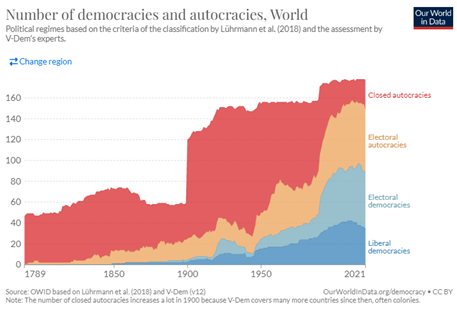
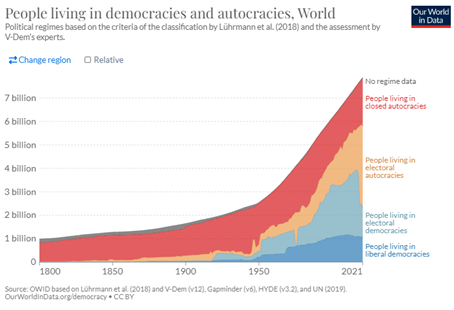
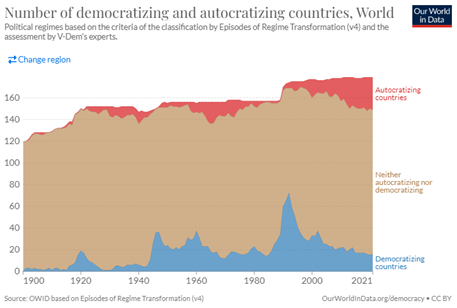
There are whiffs of this trend even in the most fortified democracies around the globe as I’ve mentioned, but the key question to ask ourselves is why democracy is in decline in the first place and what are the factors at play expediating this decline? Aside from my view that there’s socio-political complacency in many democracies (US, UK & France are some examples), the key reasons in order of importance are:
- Populism
- Go on? A mindset shift that moves away from the status quo towards an often muddled, but sometimes justified, conception that what has gone before is now not fit for purpose.
- Economic inequality and the associated social discontent
- Go on? The distance between the ‘haves’ and the ‘have nots’ antagonises people’s ideals of what is just in society and acts as rot in the trusted belief that society works for the benefit of all.
- Cultural conservatism
- Go on? Xenophobic tendencies have crept in over the last decade to the point where they galvanise more purist national ideologies (largely through shared social media platforms that create a tunnelling effect) which culminate in a more homogenised acceptance of questioning whether diversity of thought and political affiliation is in fact needed.
- Personalism
- Go on? An individuals over idealistic sense of importance over a typically weakened political party fostering a stronger desire to concentrate power and undermine horizontal accountability.
Populism, as Pippa Norris acknowledges, is one of the largest threats to Western liberal democracies alongside acts of terror. It is, as Norris defines, a governing style defined by three features (known as ‘the features’ herein):
- A rhetorical emphasis on the idea that “legitimate political authority is based on popular sovereignty and majority rule”;
- Disapproval of, and challenges to the legitimacy of, established holders of “political, cultural, and economic power”;
- Leadership by “maverick outsiders” who claim “to speak for the vox populi and to serve ordinary people”.
Each of these are quite full-bodied in their depth so I’m going to focus on just the effects of populism for the rest of this paper and leave the other three points to be left mulled in the minds of the reader. Taking each of the features in turn, the first point isn’t too surprising and is commonly referenced within the works of liberalist schools of thought such as Hobbes, Locke & Rousseau. It simply refers to the state and its government being created and sustained by the consent of its people, who are the source of all political power. If the consensus sways towards the thinking that consent is no longer being granted by the people by virtue that the political powers having drifted from manifestos means a want for change naturally follows. In other words, if those in power do not reflect the wants of the people, the people collude and seek to resent. Nothing too abstract here I would say.
The second feature is key and gets to the heart of the matter. Once it is felt that the ruling parties are no longer working off the consent of the people, an entrenchment of all that ‘they’ (being government) stand for is questioned and sought to be overturned. Psychologically this makes sense – if you don’t feel like the system works for you, you want it gone and it can become easy to bucket all that the current institution stands for as being vehemently opposed to your thinking even when the reality can be quite different. Once this ideal festers amongst like-minded individuals, it spirals into something with much more potency and evolves into a movement disapproving of the status quo and the actors therein. The disconnect between political ideal and reality can in some cases become quite extreme but again, the psychology is quite clear and understandable.
But how does a populist movement go about furthering this? The third and final feature states they appoint a maverick leader to speak on behalf of the ‘vox populi’ of course. A Corbynite figure if you will. This new way of acting and thinking is directly opposed to the institution to which they feel no longer represents them so hence the people become excited at the prospect that real change may come exogenously rather than endogenously.
This all makes sense and seems justified so why am I then linking it to the downfall of democracy? Well, it’s because in some instances, populism manifests itself in an authoritarian manner and can further intensify views on society that are perhaps not to the benefit of the majority but instead adhere to an often more ‘radical’ grouping. Such a risk was pronounced and evident during the presidency of Donald Trump where he benefited from the mistrust of “the establishment” and continuously sought to undermine faith in the legitimacy of the media and the independence of the courts. The anxiety induced into the system means people become further reliant on the individual (Trump in this instance) in power to show them the way, thus aggrandising their status beyond that of conventional political powers and concentrating the political views of the supporters and thus the resentment of the opposition. Other examples include Orban in Hungary and Chavez in Venezuela so it’s not an uncommon phenomenon. When these events happen, the wider institutions’ ability to provide checks and balances is diluted and can in some cases make those who feel ideologically opposed increasingly marginalised. This builds to create greater divides in society and thus greater social instability and in turn reduces the populist groups’ desire for democratic institutions given they have developed such an entrenched view of the world and the people they share it with hence seeing no reason to change it.
Right, well, I think we can agree there’s quite a lot to unpack so bringing this all back, the point this paper is making is that the things we take for granted can and will gradually shift in ways we don’t fully understand if the shorter-term consequences of socio-political complacency, oscillating social patterns and economic misconduct continue to evolve in a disjointed manner no matter how severe. The degree to which populist tendencies develop over time can increasingly undermine democratic principles which threaten to destabilise the one thing that maintains our current societal and economic order: democracy (no prizes for getting that right). Therefore, whilst the plate of democracy is by no means broken, it is certainly not sat elegantly on the shelf like it once was and now finds itself pressed up awkwardly against the glass door of neomodern hermeneutics.
 The bulls and the bears
Leave a comment